
The Vision: Autonomous Public Transport
Autonomous public transport is not simply about removing the driver from a bus. The real opportunity is much larger.
Autonomy means making the entire transport system intelligent.
AI agents can work together across planning, routing, scheduling, fleet management, dispatching, maintenance, passenger services and continuous optimization.
Human experts remain in control — setting objectives, policies, safety requirements and constraints — while AI handles the enormous volume of decisions required to operate a modern transport network efficiently.
The result is a public transport system that:
- understands where people need to travel.
- dynamically matches capacity with demand.
- responds to disruptions before they become major problems.
- continuously learns from its own operation.
- provides better service with fewer resources
AI agents for every process
Public transport has traditionally been built around fixed routes, fixed timetables, centralized control rooms, and large teams manually coordinating an increasingly complex system.
Einbus envisions a different future.
We are building toward Autonomous Public Transport: a system where AI agents continuously understand demand, design and optimize the network, coordinate vehicles, respond to disruptions, and improve the service based on real-world data.
Instead of one system trying to do everything, specialized AI agents work together across the entire public transport lifecycle — from long-term network planning to the decisions made every minute on the road.
01 — Network Planning Agent
Understand where people need to travel

A successful public transport network starts with understanding mobility demand. The Network Planning Agent analyzes population, workplaces, schools, services, mobility patterns, events, existing transport infrastructure and other sources of information to understand where people need to go — and when.
- Areas with high and growing transport demand
- Underserved neighborhoods
- Major origins and destinations
- Transport hubs and interchange opportunities
- Peak and off-peak travel patterns
- Opportunities to replace private car journeys
02 — Route Optimization Agent
Design the right network for every journey
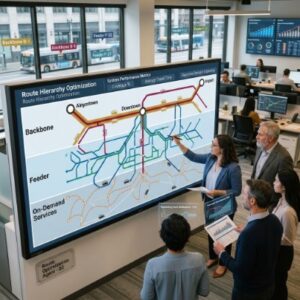
Instead of treating routes as permanent lines on a map, the Route Optimization Agent continuously evaluates how the network is performing. It designs and optimizes a hierarchical network consisting of:
Backbone routes
High-capacity, frequent connections between major destinations and transport hubs.
Feeder routes
Flexible services connecting neighborhoods and local areas to the backbone network.
On-demand services
Dynamic routes that adapt to passenger requests and changing demand.
The agent evaluates coverage, travel times, transfers, vehicle utilization, operating costs and passenger demand to find better combinations of routes.
03 — Stop Network Agent
Put the right stops in the right places
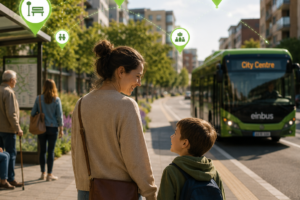
Bus stops are the interface between the transport network and the passenger. The Stop Network Agent designs and evaluates stop locations based on accessibility, walking distances, safety, demand, road infrastructure and connections to other services. It can identify:
- Missing connections
- Stops with low utilization
- Areas with excessive walking distances
- Opportunities for new mobility hubs
- Safer and more accessible stop locations
For dynamic public transport, the stop network becomes even more important: vehicles need an extensive set of safe and efficient locations where passengers can be picked up and dropped off.
04 — Scheduling Agent
Allocate transport capacity where it is needed, when it is needed.
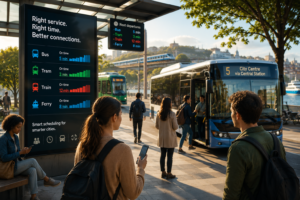
Traditional timetables are often designed months in advance and remain largely unchanged even when demand changes. The Scheduling Agent continuously balances passenger demand with available vehicles and capacity. It optimizes:
- Departure frequencies
- Peak and off-peak service
- Vehicle assignments
- Transfer synchronization
- Driver and vehicle availability
- Connections between buses, trains, ferries and other modes
05 — Fleet & Operations Agent
Coordinate the entire fleet in real time
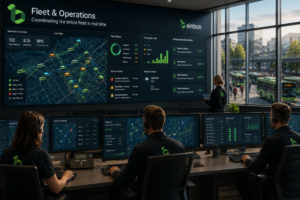
The Fleet & Operations Agent combines vehicle coordination, dispatching and real-time operational management into one intelligent system. Every vehicle becomes an active participant in the network. The agent continuously monitors:
- Vehicle locations
- Passenger loads
- Traffic conditions
- Delays
- Vehicle availability
- Battery state and charging needs
- Service disruptions
- Network-wide demand
When something changes, an optimal response is produced. For example, when an accident causes congestion, the agent identifies affected routes, reroutes vehicles and protects important passenger connections. Instead of a central control room manually reacting to every event, human operators supervise an AI system that is constantly watching the entire network.
06 — Maintenance Agent
Prevent failures before they happen
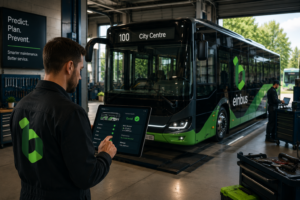
A vehicle breakdown does more than remove one bus from service. It can disrupt an entire network. The Maintenance Agent combines vehicle diagnostics, mileage, operating conditions, historical maintenance records and sensor data to predict when maintenance is needed.
07 — Dynamic Pricing Agent
Match price, demand and available capacity
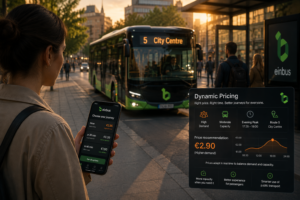
Public transport pricing is traditionally relatively static. The same journey can cost the same regardless of whether a vehicle is nearly empty or operating at maximum capacity. The Dynamic Pricing Agent introduces a more flexible approach. It continuously analyzes:
- Passenger demand
- Available capacity
- Time of day
- Route utilization
- Upcoming events
- Service frequency
- Alternative routes
- Operating costs
- Passenger price sensitivity
The agent adjusts trip prices to respond to demand and make better use of available capacity. This encourages passengers with flexible travel times to shift their journeys away from crowded periods while making underutilized services more attractive.
Dynamic pricing also includes special offers, off-peak incentives, subscriptions and targeted mobility campaigns.
08 — Passenger & Mobility Agent
Make public transport personal

Passengers do not need to understand how the transport network works. They simply need to know where they want to go. The Passenger & Mobility Agent combines journey planning, passenger communication, ticketing, payments and mobility services into a single intelligent interface. It can help passengers find the best journey based on their preferences, such as:
- Fastest journey
- Fewest transfers
- Lowest cost
- Accessibility requirements
- Walking distance
- Real-time disruptions
- Preferred departure time
The agent also manages payment across multiple transport modes and operators.
09 — Network Intelligence Agent
Learn from every journey

An autonomous transport system should become better every day. The Network Intelligence Agent analyzes what actually happened across the network:
- Passenger demand
- Journey times
- Waiting times
- Vehicle utilization
- Missed connections
- Delays
- Route performance
- Operating costs
- Customer feedback
It compares planned performance with real-world outcomes and identifies opportunities for improvement.